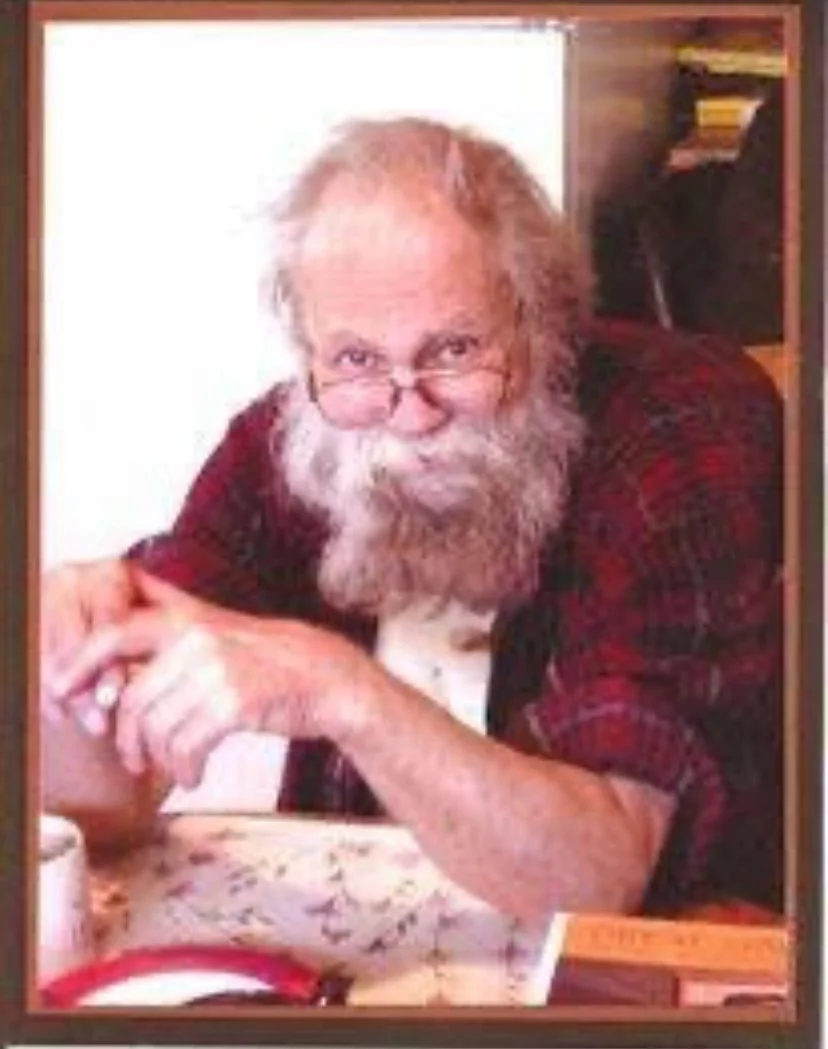
Physicist, painter, carpenter, civil servant and more…
Tom Galbraith
a Real ‘character’

by Charles Shaw, Editor New Hope Gazette, 4/26/84
Do you know Thomas Lee Galbraith, the aerospace physicist?
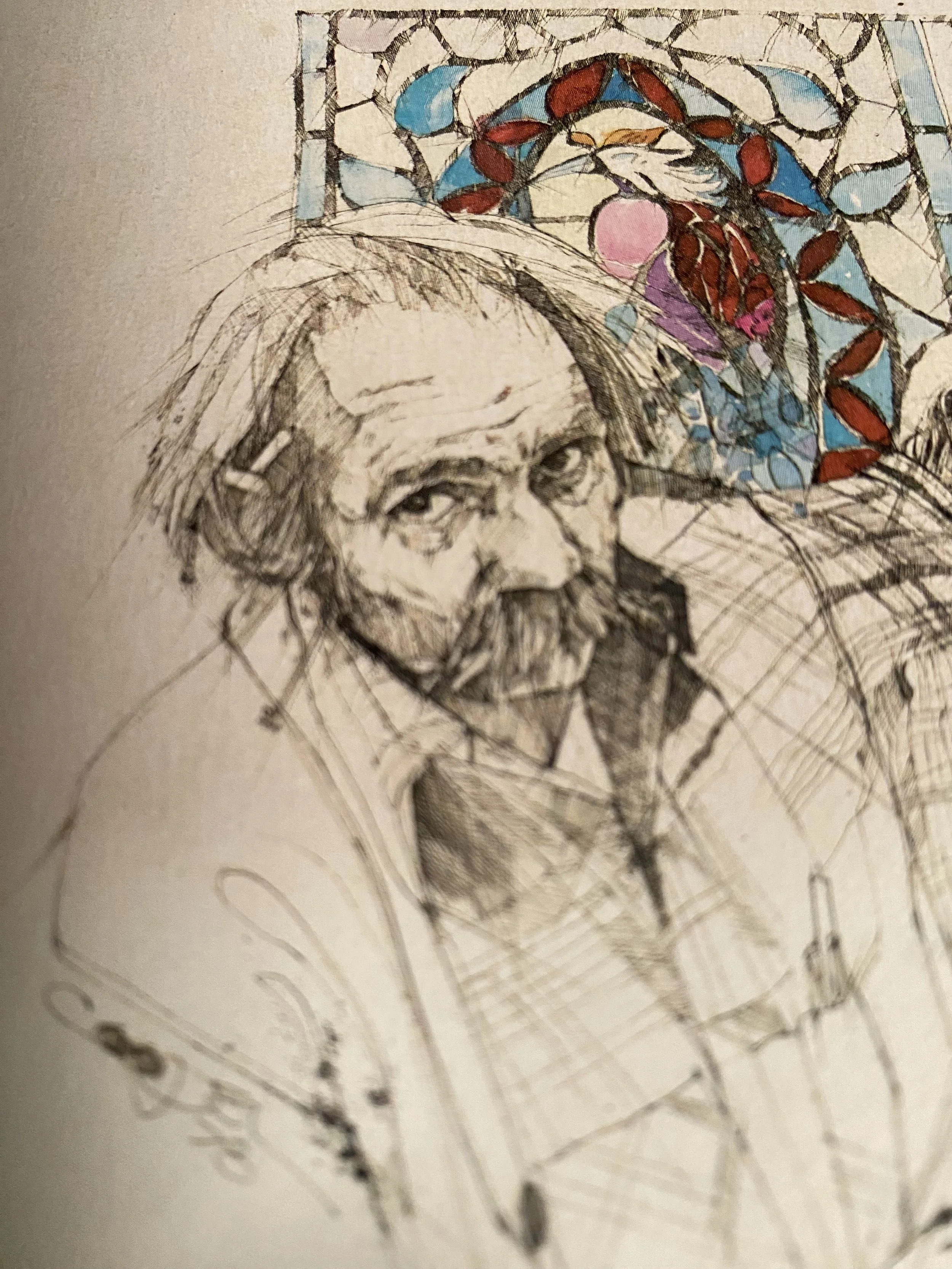
How about Tom Galbraith, the painter-sculptor?
Or Tom Galbraith, the stained-glass artist?
Maybe Tom Galbraith, the woodworker?
Tom Galbraith, the carpenter?
How about Tom Galbraith, the former New Hope Borough Planning
Commissioner as well as the former New Hope Zoning Officer?
Tom Galbraith, the Eagle Fire Company volunteer?
Or Tom Galbraith, everybody's friend, liked by everybody who knows him, most
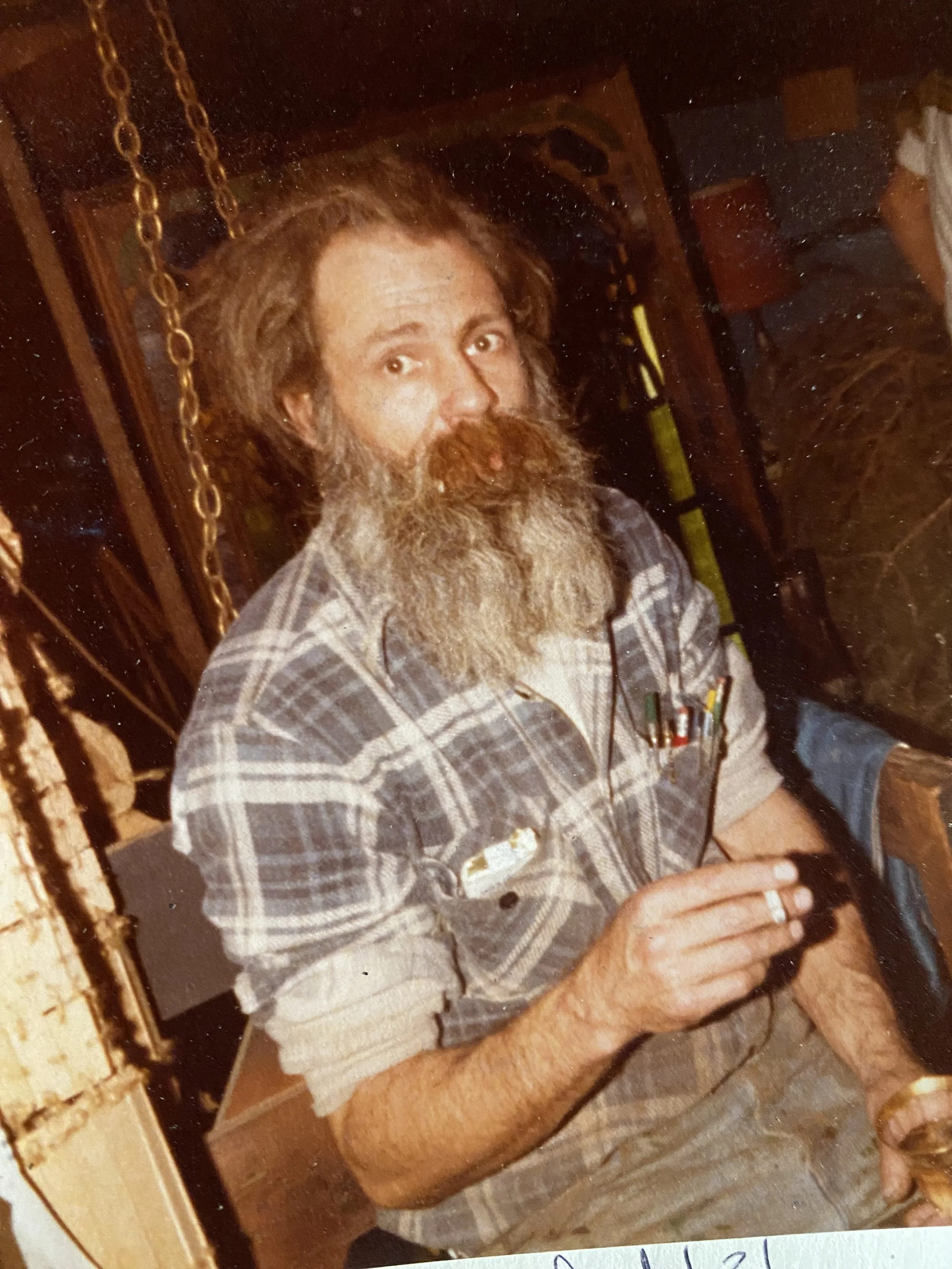
of whom refer affectionately to Tom, with his thick mustache, long beard and
daily outfit of workingman's clothes as a "character"?
This many faceted man, about to observe his fiftieth birthday, certainly is one of New Hope's most interesting characters (and it takes a lot of individuality to be among the most interesting people in this town of individuals) as well as one of New Hope's most accomplished residents. He is known as a man who does his best when he's faced with the impossible -- such as his current project of renovating the old Roy Large planing mill on Buttonwood Street. Tom, Cindy Wuthrich and Cindy's aunt, the late Berenice Casper bought the mill, an adjoining residence facing Chestnut Street (now occupied by Cindy's mother) and a long garage behind the mill back in 1976. Tom and Cindy live on the second floor, which they are slowly transforming into a showplace residence, while the first floor is an arts and crafts showplace for stained glass work, tile-making, lapidary work, Cindy's jewelry-making and other crafts.
The third floor is Tom's painting studio (except for paintings too large to get through the third-floor door – paintings which are then done in the living room). The top of the long garage is an apartment, and the garage bays below have been made into a craft shop for woodworker Alan Rockwell and the Brass/Beds factory.
Tom's back on his feet and getting ready for an October exhibition in Lambertville. He was slowed down for a while after dropping a four-inch-by-four-inch sander on his left ankle back in February when he was installing a stained-glass foyer in a house in Titusville. The wound became infected, so Tom was sent off to a hospital four days later. The infection spread into two toes, which had to be amputated. Tom was on crutches for six weeks, but he's walking without a limp and has returned to semi-heavy work.
"I never did stop work, though, " Tom said in conversations with this reporter during the last several weeks. "In the hospital, made sketches, did a lot of reading and planned for my October show, which will be in the Buckingham Galleries of the old People's Store in Lambertville. Now l can do some lifting, and l hope it won't be long until I am able to answer some fire calls for the Eagle. "
How did this remarkable man, born and raised in St. Louis, Missouri, come to live in New Hope and fit into this unique scene of ours as if he had drawn his first breath here? It's a complicated story, and it's pure Galbraith.
I will tell the story as l have unraveled it during the past 20 years and as Tom updated it for me in the last few weeks. If this report rambles, it's because the Galbraith story is a rambling one.
Studio on third floor
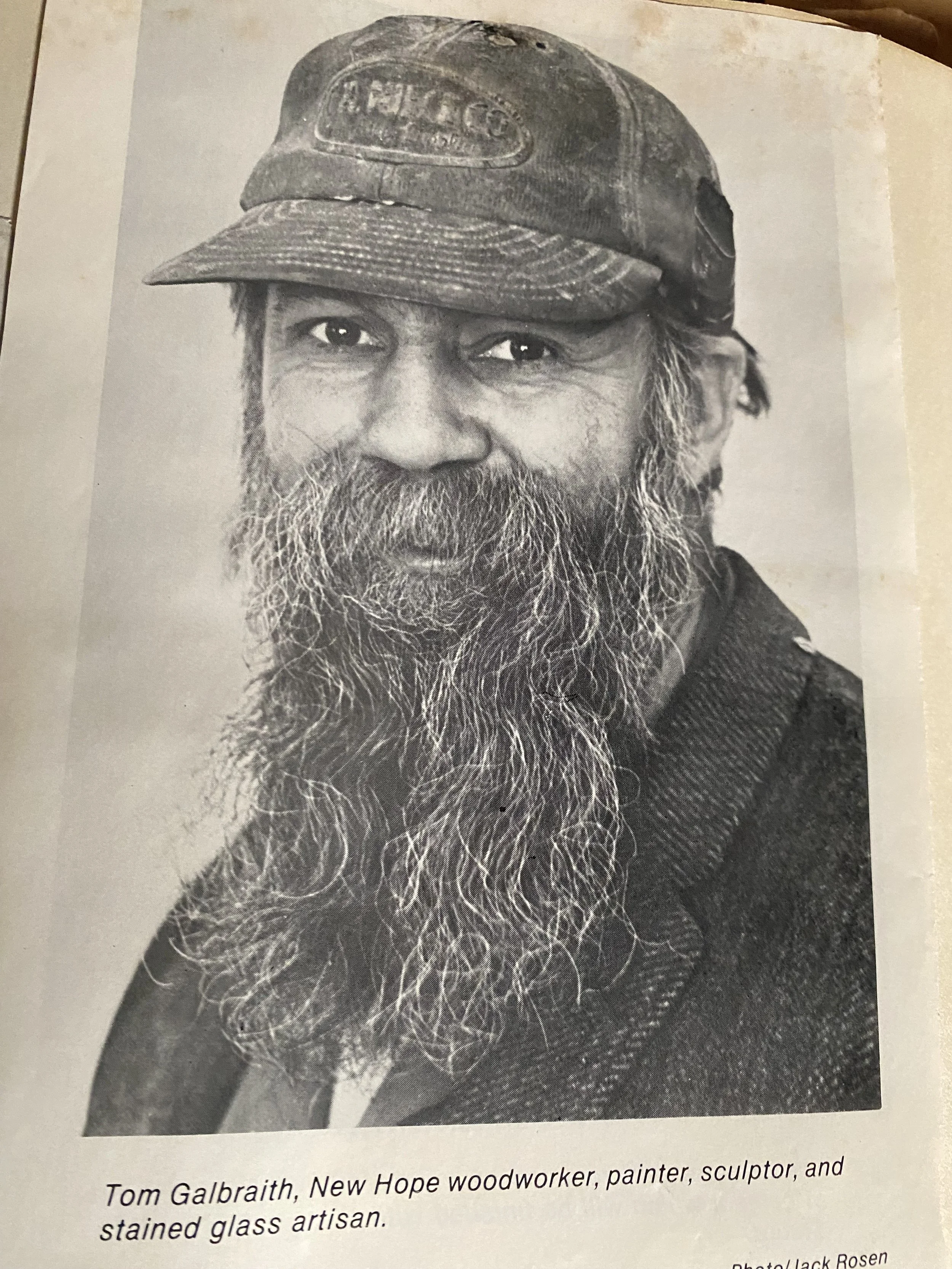
Photo by Jack Rosen
"My job was to define the radiation environment in the VanAllen belt -- the particles that make up that radiation environment. There is a multitude of radiation levels, you know -- protons and electrons are familiar terms. There also are pious, moons and other words ending in 'on' -- generated by cosmic rays. Out of it came a two-inch thick report on radiation damage to man, which was used in developing radiation shielding for space vehicles, especially on their trips through and in the Van Allen belt which begins about 120 miles above earth and as a belt of higher intensity from 500 to 1500 kilometers thick. "
Life at McDonnell continued until 1964. Tom meanwhile had married and had become the father of two children --Scott, now 22, and Leslie, now 23. His wife was a native of Minneapolis working in St. Louis.
"She didn't like the Midwest " Tom recalled. 'She wanted us to come East. She got a job in Washington. Our marriage wasn't very smooth, but I thought I’d give it another try I was interviewed by General Electric and got a job at the Valley Forge plant in 1964. I was hired to head up the environmental section of the reentry system. That was atmosphere physics, or aerospace physics.’
“The first job was to define rain - to study the droplets of rain and their composition. Why was that important? Well, a space vehicle traveling at its extraordinarily high speeds would disintegrate if it tried to fly through rain. That's why you don't take off or re-enter when it’s raining.”
"The next thing you know we were looking into the particles of' ‘anything' We studied the wind-blown particles on the surface of Mars in preparation for unmanned landing of Voyager Marines etc.”
Defining radiation
Tom was born June 6, 1935, in St. Louis. His mother worked for McDonnell Aircraft in St. Louis. His father, who was separated from Mrs. Galbraith when Tom was young, went to Dallas as an insurance salesman.
One of Tom's uncles was a painter, living in Dallas, and he got Tom interested in art.
"I've been drawing since I was five, " Tom said. I used anything I could get -- brushes with oils, pastels, crayons, chalk, on oils and paper l did mostly landscapes and animals.
"I did murals in grade school. My class did one of the Revolutionary War on paper -- four feetby20 feet We got out of class to do that. That added to the fun. Then l went to a military high school and did some painting now and then. When l was 18 and out of high school, l started painting seriously "
Tom's mother asked him what he wanted to do when he finished high school, and Tom said he wanted to go to college.
"Actually "he recalled, "I wanted to be a Navy flies, but I needed two years of college to qualify for flying school. Igor my two years of college in (St. Louis University), and I joined the Navy I got into flying school, but I washed out as a Physicist, painter; sculptor; carpenter civil servant and more...
cadet. Some people blamed it on my Poor mental attitude'. I wasn't cut out to be a flier. After two years in the Navy I went back to college.
"When I went to St. Louis University right after high school (and being interested mainly in qualifying for flying school) I took the only courses l was interested in. l like the idea of math and physics... I found them very interesting. So, when I went back to college in 1958, I selected physics and math, as well as philosophy) as my majors, and I got my B.S. degree in 1960. "
Tom's brother at that time had applied for a job with McDonnell and Tom helped him with his exam. Both brothers were hired. That was in 1958 - a landmark year. That was the year when the Soviet Union launched Sputnik, the first man- made satellite in recorded history. Tom was only a student then, and he was assigned to work as a technician in rocket propulsion. The first project on which he worked was to define rocket motors for specific jobs -- for example, to calculate the thrust for lift-off and to make other calculations and observations for both ballistic and glide missiles. One of the first research vehicles he worked on was named "Dynasoar", which was designed but never built.
"Actually " Tom recalled, "it was the forerunner of the space shuttle. "
Sputnik went up but it ceased transmitting after a relatively short time. The United States, after a series of failures, launched Jupiter, but its transmission, too, had a short life. Dr. James Van Allen, who became a good friend of Tom, discovered the radiation belt around the earth, immediately names the Van Allen belt, and radiation was suspected as the cause of interrupted satellite transmission.
"Since I had studied and otherwise researched particles physics, "Tom recalled, "my boss asked me to take over
particle physics in McDonnell’s space program." (Particle physics is the study of constituents in a particular field of
studies -- the particles that make up radiation, rain, etc.)
Born in St. Louis
'To do that study, we used telescopic observations of the surface of Mars, the general principles of particle transports, mass spectrograph studies with their color variations, meteoroid distribution, the asteroid belt and other phenomena. What we were doing was searching for definitions that would enable engineers to design. "
As a result of that work, Tom read papers he had writen about the Van Allen belt and 'The Droplet Distribution of Rain" to meetings of the American Geophysical Union in Washington and San Francisco - the results of three-year studies condensed into 15 minutes.
Shortly after going to GE, Galbraith moved to New Hope. (His marriage was over.) He rented a studio in the old Pickett building at the corner of Mechanic Street and Ney Alley and later moved to47 Old York Road.
"I had a 'magical’ reason for coming to New Hope. I had never been here, I had heard of it only once. A fellow I knew at McDonnell told me he had an uncle who was a magician, who was billed as 'Sheetz the Magician' He lived in New Hope, and his nephew said to me, 'From what I know, I think you’d like it there. It's arty a little offbeat. So, I came here the first chance I got, and I stayed here.
"I came to know other artists – Dave Amedeo, Harry Rosin, Flegal, Rad Miller, Ray Halacy, and I came to really love it here.’
Searching for definitions